

Crucial Hire
The Empty Chair Tax
What an open leadership seat quietly charges you every week it sits. Nobody puts it on a budget line, which is exactly why it goes unpaid attention for months.
By Zach Nold, Chief Talent Officer at Crucial Hire, an HR-only executive search firm based in Chicago, Illinois, placing HR leadership nationwide.
The short answer
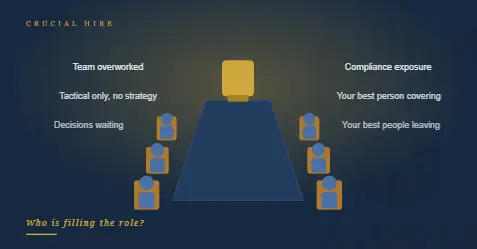
An open leadership seat costs money every week whether or not anyone is tracking it. The cost shows up in four places: the salary you are saving, the work that stops, the people absorbing that work, and the decisions nobody is making.
Only the first one is a saving. The other three are charges, and they compound. Most companies notice the saving on the P&L and never calculate the other side, which is why an open executive seat can feel financially comfortable while quietly costing more than the search that would close it.
There is one line in the budget that gets happier every month a leadership seat stays open.
Salary savings. It is real, it is visible, and it lands in the same report every leader reads. A CHRO seat open for four months is four months of a large salary not spent, and the number sits there looking like good news.
Everything else the empty chair costs you is invisible, unbudgeted, and considerably larger.
Where the money actually goes
The point of what follows is not a benchmark. Your number depends on your business, and anyone who quotes you an industry average for this is guessing. What matters is that you run the arithmetic for your own seat, because almost nobody does.
The salary you are saving is the only number anyone can see. It is also the smallest number in the equation.
Why the tax compounds rather than accumulates
A cost that accumulates goes up in a straight line. A cost that compounds gets worse at an increasing rate, and that is what an open leadership seat does.
Month one, people cover. Month two, they are still covering and starting to feel it. Month three, the strongest person doing the covering starts wondering whether this is permanent, and whether they are being tested or taken for granted. By month four you are running two risks instead of one, because now the person holding it together is also a flight risk.
Meanwhile the search itself gets harder. A role that has been open a long time is a harder story to tell a strong candidate, and the good ones ask why.
The version of this that costs the most
Keeping the seat open while you decide whether the role should change.
Waiting to see whether an internal person grows into it.
Restarting a search after three months because the requirements shifted.
Treating a long runway as a reason to move slowly.
Deciding what the role becomes first, then opening the search once.
Testing the internal bench honestly in two weeks, not two quarters.
Bringing in interim leadership so the permanent hire is never made under pressure.
Committing to a slate with a date attached, so the search cannot drift.
Interim leadership deserves a specific mention, because it is the most underused answer to this problem. An interim leader stops the compounding while the permanent search runs properly. It costs money, and it costs less than a rushed hire that does not hold. Terms are on the pricing page.
What good looks like
The seat is open for as long as a real search takes and not a week longer. The people covering know exactly when it ends. The work that stalled is named and sequenced rather than quietly abandoned. And the person who eventually walks in stays 4 to 10+ years, which is the only version of this where the arithmetic ever comes out ahead.
If the seat is open because a leader is retiring, the sequencing is different and it matters. That is covered in replacing a retiring CHRO and how much notice a retiring CHRO should give.
How long has your seat been open?
Thirty minutes, and you will leave with a timeline and an honest read on what the delay is actually costing, whether or not we ever do business.
Book a Strategic Talent CallZach Nold is the founder and Chief Talent Officer of Crucial Hire, an executive search firm in Chicago, Illinois that places HR leadership exclusively, from HR Manager through CHRO, for companies across the United States. 312-612-1981 | zach@crucialhire.com